Deeps
phone: (805) 428-6179
e-mail: thinkindeeps@gmail.com

Friday, January 04, 2013

Struggling with Evolution: Seven Misconceptions

Darwinius masillae holotype fossil (46 Million Years Old)


  "I am not a monkey and my grandfather was not a monkey so how could evolution be real?"  This statement might seem ridiculous to some and yet this sort of misunderstanding of evolution is found throughout society.  Perhaps it is the expansive temporal scale of evolution that is leading to so many misconceptions and false ideas.  Or maybe there are too many cultural barriers that are obstructing its progress.  Either way, I thought I would take this opportunity to to address Seven Misconceptions of Evolution:

1. Humans evolved from monkeys, so why are there still monkeys:   

    Humans did not evolve from modern day monkeys.  Instead, humans and modern day monkeys both evolved from a common ancestral species who was definitely monkey-like, but not at all the same as modern day monkeys.  From this common ancestor we see a split in the evolutionary road, some of these roads lead to modern day monkeys and other species of primates, and one of them leads to Homo Sapiens, modern man.  So instead of thinking of Apes as our evolutionary fathers, we should then view them as our cousins from a very ancient common ancestor.  Example of one of our common ancestors link


2. We have no evidence of speciation (one species evolving into another):  

    Actually....Yes we do, there are multiple cases in both plants and animals where we have seen speciation events where one species evolves into a completely separate species in the modern age.  (examples: Cichlid fish, Rhagoletis pomonella, goatsbeard plants, Epilobium angustifolium: Speciation examples.)  But what is a species?  Most people who ask for this type of evidence are unknowingly unfamiliar with this term.  A species is most commonly classified as a organism that can interbreed and create viable offspring in a non-laboratory environment.  This definition does not require large physical differences that can be evaluated with visual cues.  Many species have close evolutionary relatives and look very similar but cannot interbreed with and thus they are different species.  So what these skeptics really want to see  is something like a fish turning into a monkey in modern times.  This is a misconception that stems from a inability to grasp the large timeline of evolution.  For large scale evolutionary change to take place time is needed, on the scale of millions of years.  Life has been evolving on planet earth for 4 billion years and it has had a lot of time to change and evolve.  Luckily, we do have the fossil record to show us transitional stages between species and the vast diversity of life.  List of Transitional Fossils


3. Evolution denies the existence of a creator:  

     First of all, there is no clause in evolution that denies the evidence of a creator.  Evolution simply outlines a theory that can most accurately describe the observed changes in biological history.  Same as how the theory of gravity (Newtonian and Einsteinian) does not deny God made the cosmos because it can accurately describe the birth and death of stars and the formation of galaxies.  The strength of a theory depends on its ability to describe phenomena and be backed by evidence both experimentally and observation-ally.  Using this criteria, evolution does prove to be a very strong theory based on evidence and is very helpful when making predictions and explaining events.  This is not to say that evolution could not be a mechanism of God's creation.  In fact, it might be more profound and truer to suggest that God created us using the unchanging and steadfast laws of nature that are such a great reflection of God himself.


Bill Nye "the science guy" Perspective:


4. We do not know how life began so then evolution must be wrong:  

    It is true that science is still at a loss for exactly how life began.  We do see the building blocks for life (amino acids) throughout the universe and the elements of life are among the most common in the universe. (H, O, C, N)  So the materials of life are not rare, but the configuration of these materials to form an organism does seem relatively rare.  Seeing as there is only one known planet that harbors life.  And so there are many theories for how life first formed (none with definitive evidence): some suggest it to be a eventuality of complex chemistry, some state it to be pure luck, and some even proclaim that life carries with it the necessity of a intelligent creator.  Whatever the right answer for this question is, the misconception here is that evolution is dependent on which of these is correct.  Evolution describes the behavior of living organisms over time, not the initial creation of life itself.  We similarly do not know exactly how matter and energy came to be, but we still have theories (even laws) that describe the behavior of that same matter and energy. However life first formed does not matter to evolution.  But once life did arrive, it seems evolution arrived with it.

See: Seven Theories of How Life Began

5.  Complex structures, like the eye, are too complex to evolve in one stage and the parts would have no benefit to be selected for:  

    Yes there are many complex structures throughout biology.  The eye is a great example of this.  And for each part of the eye to evolve, the genes that brought forth each part individually had to give some advantage to the organism as a whole.  An advantage that allows it to better pass on these genes.  What we forget is that a trait can be a addition or a subtraction from a structure.  For a building to be built, there must be a scaffolding that is first erected that gives stability and functionality to the structure.  Once it is complete this scaffolding can be removed.  In many cases in evolution it can be theorized that a scaffolding allowed for a complex structure to be built that still gave the organism a distinct advantage.  In the case of the eye, light sensitive cells were definitely a advantage, allowing organisms to orient themselves or even seek out heat.  Later came the focusing of this light through some rudimentary device, that was then removed as the lens of our eyes became the prominent mode of focusing light.  We see many different levels of complexity of eyes throughout the animal kindgom and the fossil record that point to a gradual evolution of this complex structure through addition and subtraction of components.  Evolution can change structures, re-utilize structures, or even take structures away completely.  The only rule is that the trait must promote the proliferation of that gene in the given population.


6. Humans are the pinnacle of evolution:  

     I hate to stomp on the ego of man but we are far from perfect.  If we were, we wouldn't be so preoccupied battling disease, starvation, and war.  A main principle of evolution is that there is no end goal, it is not traveling in any specific direction.  Clearly humans are dominant at this time on our planet and it is easy to conjecture that we are a superior species.  But drop one of us in the Jurassic period or in a early earth before the ozone was formed and quickly we seem much less equipped for survival.  This is because evolution only works to generate species that are best adapted for their current environment.  And since environments are constantly changing, so are species.  Yes, there are some traits (possibly intelligence or population cooperation) that a case can be made for their advantages in any environment but even still, their definition and biological utility is constantly changing.  It seems as though evolution is in the nature of biology itself and it's forces will always be felt in living populations.  However, it is a mysterious force and our own preconceptions of progress and goal oriented mechanisms can often get in the way of our understanding.

Dr. Neil deGrasse Tyson calls some aspects of human anatomy, "Stupid Design."


7. Why aren't organisms still evolving?:   

      One of the biggest hurdles when trying to understand evolution is the vastness of the time scales involved.  It is very difficult for people to understand what a million years means,  let alone hundreds of millions of years.  These amounts of time are not experienced in our lives and yet even in our lifetimes we do see change.  We see adaptation in organisms, we see changes in some species' physical appearance, and (as I stated earlier) we can even see speciation events in our lifetimes.  So then, we can extrapolate these changes over the large evolutionary timeline and see that life is in fact still evolving.  Though it might be a small rate of change, the amount of time involved is so staggering that small changes can give rise to incredible transformation and diversification.


-by: Brett Vollert


Homo Futurus: A Challenge to Darwinian Thinking
(documentary on the evolutionary past of humanity and its future through a unique posible counter-darwinian mechanism)


Friday, December 14, 2012

December 21, 2012: Mayan Apocalypse


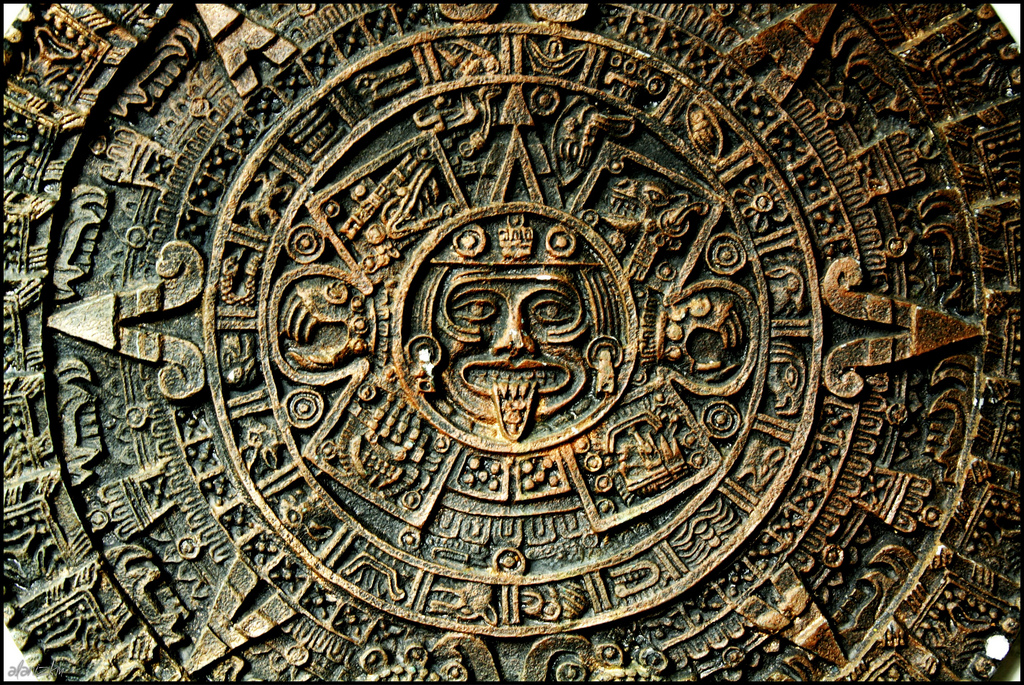
    There is a lot of misinformation out there so let's set the record straight before we all start running for the hills.  Because after a few ridiculous blockbuster movies and  some thought-provoking history channel documentaries we are now a society closely approaching a highly anticipated date.  The Mayan calender known as the long count will end its 13th baktun (a period of 144,000 days) which marks the end of the first "Great Cycle" on December 21, 2012.  There are questions on the accuracy of this date due to the calendar not accounting for leap years, however the issue of leap year only plays a role in calendars that count years.  This calendar simply counts days and is independent of the solar year.  The Mayans have just been counting the sunrise and sunset for thousands and thousands of days.  Perhaps the misconception has stemmed from use of the word calendar and the Mayan Long Count is more of a day recorder.  None the less, it has been recording for something like 1.8 million days since the beginning of the first baktun (August 11, 3113 BCE).  And on December 21 of this year the calendar will reach 1,872,000 days, the day recorder will reset, and we will enter into the 14th baktun.  The number 13 was considered a holy number by the Mayans who thought there to be 13 levels of heaven, thus the "Great Cycle" comprises of 13 baktuns.

   So that is what the Mayan Long count "is," but what did the end of this "Great Cycle" actually mean to the  ancient Mayans?  To see time as the Mayans did we have to strip away the prejudices and preconceptions of our Western thought.  Western man sees time as linear, it begins at some point and ends at another.  However, the Mayans saw time as cyclical; what has happened in the past will happen again and time is comprised of looping events.  Their culture makes no claims that the end of the world occurs when the "Great Cycle" ends in 2012.  Instead, it is the turning over into a new era, a period of change and renewal, which has been speculated as meaning that this world must be destroyed for a new one to begin.  This is not necessarily the case.  We see similar renewing mentalities in our own culture each January when our calender resets and the gyms are swarmed by new years resolutioners.  What we don't see is people worried the world is going to end every year on December 31st.  At least not sane people because it is simply the beginning of a new cycle around the sun.

    But all ancient Mayan cultural speculative significance aside, why would we trust a ancient civilization to predict the end of the world in the first place?  Where does this confidence in their astronomical and temporal predictions come from?  To their credit, the Mayans were in fact great astronomers for their time, thought to be obsessed with the happening of the stars.  Without a sextant or any modern technology, they were able to predict lunar events within seconds 1,500 years into the future and they also very accurately charted the orbits of planets, such as Mercury,  Mars and Venus.  The Mayans are also thought to have predicted the alignment of the earth, the sun and the center of the Milky Way galaxy on December 12 of 2012.  Some have suggested that this alignment will invoke gravitational effects that could throw the earth off its axis or even out of orbit. And while the gravitational effects of this alignment are mathematically negligible, there is a easier way to prove this theory wrong.  The Earth, the Sun, and the center of the galaxy will align on that day, that much the doomsday theorists have gotten right.  But what often is overlooked is that this alignment occurs EVERY YEAR on December 21, which is known as the winter solstice.  And since we have survived every previous winter solstice, our past suggests we will also survive this one.  There are also many other fabricated theories on alignments of planets which will cause the planets to waver off their orbits.  These are simply not true, there is no special alignments of planets on 12/21/12, and the only significant sources of gravity on the earth are the Sun and the Moon.


December 21, 2012...Just Another Day
NASA Jet Propulsion Lab


   Doomsday 2012 advocates will tell you that the precision of Mayan astronomy must have been influenced by gods or aliens because their knowledge is too great for their time period.  Also that these aliens shared with the Mayans their knowledge of the universe and even told them the date of the end of the world (a idea made even more famous by the TV show: Ancient Aliens).  However, if the Mayans did have aliens telling them the secrets of the universe, a lot of the basic secrets were left out.  For instance, the Mayans thought the world to be flat and resting on top of a giant crocodile and they also were unaware of the structure of our solar system, viewing the planets as simply faster moving stars.  More significantly, if December 21st is the end of the world, that would mean the Earth began at the beginning of the Mayan "Great Cycle" on August 11, 3113 BCE, which is only a couple thousand years ago.  However, geological and astronomical evidence has proven the earth to be just over 4.5 billion years old.  This means the Mayans wrongly calculated the beginning of the Earth by over 4 billions years! Why then should we trust the Mayans to predict the Earth's end?

   But even more far-fetched are the rumors surrounding the proposed planet, Nibiru.  This planet was first introduced by the writer and ancient alien theorist, Zachariah Sitchin.  Sitchin stated that the ancient Sumerian culture was aware of a extra planet that follows a very elliptical orbit around the sun.  This planet has no real link to the Maya other than their shared interest in astronomy.  Nibiru is speculated to be slowly approaching the earth and will either crash into the earth or have intense gravitational effects on it.  However, if this planet was approaching it would be very visible at this point and there has also been no effects on any neighboring planets that suggest a unwelcomed visiting planet.  Some suggest that the planet has been observed by NASA and other government agencies and they are working hard to keep it under wraps.  If this is true then they would have to confiscate every telescope in the world.  Honestly I haven't checked in a while, but I'm fairly certain my telescope is still collecting dust in the garage.  On top of that, this is based on only one mans interpretation of a ancient text that at the time very few people could read.  However, the few that can now read ancient Sumerian assert that Sitchin has twisted the language to fit his own theories and in some cases even gotten translations completely wrong.  The errors in his translations were so great that some accused Sitchin of not being able to read ancient Sumerian at all.

Zachariah Sitchin Debunked


   Conveniently, most of the astronomical claims of  the 2012 doomsday advocates are very testable with a telescope or a astronomy computer program.  However, there are a few that would have little more warning than a flash of light immediately before our destruction.  A solar flare followed by a coronal mass ejection is a emission of high energy particles from our sun that if aimed directly at earth with a large enough energy could do considerable damage.  These ejections happen very frequently and our planet is fairly consistently bombarded with material from the suns solar flares.  Luckily for us, the Earth has a magnetic field that shields us from these particles.  But if the solar flare was large enough or if the shields were down, we would be showered with radiation and electromagnetic waves that could incinerate all life in a instant.  However, there is no indication that the Earth's magnetic field will shut off.  Even during periods of magnetic pole inversion (when the north and south poles switch their orientation) it continues to protect us from solar radiation even though our compasses would need re-calibration.   Moreover, the sun is currently in a period called a solar minimum, which is a time of low solar activity.  During this time it is extremely unlikely that there will be a coronal mass ejection large enough to devastate the earth.  Instead a solar flare on this day would simply treat some penguins and Eskimos up north to an aurora borealis or "Northern Lights" that this radiation causes.

    The other unpredictable and perhaps most destructive of all celestial events is a supernova.  If the world is going to end on 2012, this is how it would happen without any warning.  When a star runs out of its hydrogen fuel, gravity compresses the mass of the star and it becomes a fiery ball of immensely unstable plasma.  When all this energy is then released the explosion outshines entire galaxies.  The high energy particles of this explosion then carry a shock wave demolishing anything in its path and remodeling portions of galaxies.  The blasts can carry across thousands of light years and travel nearly the speed of light.  Any creature living on a planet in the path of this blast would be bathed in light and then instantaneously treated to a swift death by heavenly fire.  This might be the most terrifying of all the solar calamities but fortunately it is also one of the most unlikely and modern astronomy has found no candidate stars close enough to cause us harm.  So once again earthlings can rest at ease knowing that if there is a supernova, it is much more likely some other poor fools on a far away planet that will draw the cosmic short straw.

Supernova Simulation


   It seems that all evidence points towards the continual existence of the earth as a beacon of life in the universe.  Our planet has weathered 4.5 billion years without being wiped away.  But then again, it has also seen many extinctions and destructive events.  More than 99% of all species of life that have lived on our planet are now extinct and through studying the skies, we have learned that cataclysm in this cosmic shooting galaxy is humbling eventuality.  The Earth will most likely survive December 21, 2012 and many December 21's to follow but someday this will all come to an end.  This is a fact that no doubt every prophet of doom is counting on.  And so it seems man will keep prophesying its end until by sheer inevitability one of us is proven right.


*Thus, if I was to predict the end of the world it  would have to be April 13, 2036.  The day that the asteroid Apophis, according to NASA, has a one in 45,000 chance of hitting the earth.  (see video)
Neil Degrasse Tyson: Death by Giant Meteor


End of the World in 2012 - Maya Calendar


Ancient Maya: Tools of Astronomy (History Chanel Documentary)


by: Brett Vollert


Sources:

http://www.nasa.gov

http://www.scientificamerican.com/article.cfm?id=nasa-crushes-2012-mayan-apocalypse-claims

http://www.nasa.gov/topics/earth/features/2012.html#mayans

http://web.archive.org/web/20070602162121/http://members.shaw.ca/mjfinley/calnote.htm

http://web.archive.org/web/20070702005434/http://www.crystalinks.com/precession.html

http://www.nasa.gov/home/hqnews/2009/oct/HQ_09-232_Apophis_Update.html

Friday, December 07, 2012

I believe in Aliens, just not in YOU....


     I love a good UFO conspiracy as much as the next guy.  However, traveling across the universe and through the vacuum of space to probe some humans seems ridiculous.  And while the numbers are clearly on the side of the existence of extra-terrestrial intelligent life, it is hard for me to believe that these same advanced aliens fail to be able to land securely and crash into the the deserts of New Mexico.  Although if these are aliens are crashing into our planet, I have new found confidence that we could successfully defend ourselves against a alien invasion.  Because while they might be extraterrestrial, they clearly are not all that intelligent.


    There are roughly 200 billion stars in the our Milky Way galaxy and there are around 200 billion more galaxies just like it throughout the universe.  It would then make sense that there would be at least one other planet circling one of these 400 billion billion stars that fosters intelligent life.  Especially because extra-solar planets are being discovered on a weekly basis and we have even found planets that fall into the "Goldy Locks Zone," whose orbits are the right distance from their stars to allow for biological life.  Using all this information, a scientist by the name of Frank Drake devised a equation that took into consideration all of the factors that would need to be aligned in order for intelligent life to exist in the universe.  The equation showed that there are likely millions of civilizations throughout the universe and thousands even in our galaxy.  (estimated at: 10,000 radio communicating civilizations in the Milky Way)


    And so we search the skies for some like us.  Organizations like SETI (http://www.seti.org/)  dedicate their resources to listening for radio waves from distant stars.  Our radio waves from early radio broadcasts have now reached out over 100 light years from the earth and the aliens circling our closest star, 4.3 light years away, are now caught up in the drama of the TV series, LOST.
   
     But after all our searching, there is no definite evidence that we have company in the universe.  Some may think that we have looked long enough and that the lack of evidence can be considered proof.  However, we have only been listening to the universe's radio waves for a little over 30 years, and to definitively state that there is no evidence of life is tantamount to scooping a cup of water out of the ocean and concluding that there are no whales in our seas.  It will take time, but why not keep looking?  Are we afraid that we might find we are not unique?


   We are made from the most common chemicals in the universe (H, O, C, N).  So the chemicals that make us are not unique, simply their configuration.  But perhaps life is a eventuality of complex chemistry.  It was very early in the earths history that life arose, in fact, it appeared almost immediately when the earths surface stabilized after the violent period of heavy bombardment.  One would think if it was a unlikely happening that it would take billions of years to arise.  But then again life seems to make logical sense.  On the very basic level, life is simply repeating chemical patterns.  Could we then even apply the evolutionary rules of natural selection to chemicals themselves?  Would it be to far a leap to say that life itself was naturally selected?  That even matter evolves?   Because all evolution is proclaiming is that structures that have attributes that promote their continual existence, continue to exist and to multiply. The second law of thermodynamics (order in a closed system always decreases and "entropy" increases) might suggest otherwise but that law is looking at the universe as a whole. In a non-closed system, physics allows for order to increase.

    With all this said, I am still weary to believe your UFO story.  Well...I believe you saw a UFO, a UNIDENTIFIED flying object, but not a alien.  Lets not jump to any conclusions when we see a object in the sky.  Too often people see a light in the sky and they claim it was a alien craft visiting earth with no proof other than their ignorance of what the object was.  Occum's Razor is a scientific law that states that usually the simplest answer is the correct one, in biology this is called the law of parsimony.  Using this law, I conclude that there was no alien craft because it is more likely that you are simply a idiot.  Sorry but not sorry.  To over throw this law all we need is some sort of concrete evidence that aliens are in fact visiting our planet and a photo-shopped blurry flying saucer does not count.  Instead lets try to get a piece of the craft or maybe even a living or dead alien.  Because if it truly a alien craft, as Neil deGrasse Tyson suggests, the technology would be like nothing we have ever seen and the alien will likely not be DNA based.  Until that time, please stop mistaking weather balloons and low flying planes for aliens.  If we keep doing this, aliens might eventually visit and find the earth to be void of intelligent life.


      But like I said the whole alien conspiracy topic is incredibly interesting and I too find myself often falling into the drama of it all.  The way I see it; either these people are crazy, they are wanting attention and money, or they actually saw aliens.  Any of these three possibilities I find fascinating    With that said, I will leave you with my favorite clip from the "Disclosure Project," a organizational effort to bring together the most reliable sources on the Alien Conspiracy.  Clifford E. Stone was supposedly a government employee who worked on recovering crashed alien ships.


Tuesday, December 04, 2012

Our Cosmic Bubble


     Our cosmic bubble is a nurturing oasis, yet so fragile and vulnerable.   The Earth is home to us all, the only known refuge for life across the universe.  Past its thin atmosphere, we find life growing abundantly.  From the oxygen rich atmosphere, to the shielding magnetic field; the Earth seems to be almost perfectly adjusted for life.  As if the planet was made with humanity in mind.  As if this place we call home was predestined for life.  So much had to have gone right for the earth to be so hospitable.
     However, this third rock from the sun has not always been so inviting.  For most of its 4 billion year history mankind would have not found it suitable at all.  In the first billion years of its infancy it was a violent place, covered in magma and constantly bombarded by asteroids.  Volcanoes leaked toxic gasses into the atmosphere that would be fatal to humans.  It was not until the proliferation of photosynthetic species that the oxygen rich atmosphere was formed at around 2 billion years into the Earth's life.  And after this, aerobic life found the Earth full of opportunity.  It diversified and multiplied.  But this period was also full of ice ages, astrological bombardment, and mass extinctions.  Over 99% of all species that have existed have also gone extinct.  In fact, this period of time might speak more to life's perseverance rather than the earths hospitality.  But then again, this only adds the the unlikeliness of mans existence.  Made evident every time we call out into the expanse of space without answer.
    But to truly understand ourselves and our home planet, we must take a step back to see our existence from a different perspective.  We must be careful to not only see the snapshot of now.  Because we are as much our past as our present.  And to say that our planet is made for us, is to forget that life has spent the past 3 billion years conforming to this planet.  We have co-evolved.  Our environment has shaped us, while we have also shaped our environment.  Hardened by our violent beginnings and now comforted by our global reach.  Humanity should then not be so surprised by the Earth's overwhelming hospitality because we would remember that we worked for so long to make it so.

-by: Brett Vollert

Wednesday, November 14, 2012

Programmable Consciousness

   The most common assessment of human consciousness among scientists is that it has spawned from the unique complexity of the human mind.  That within our DNA lays a design for a being capable of dreams, hopes, and fears.  Yes, these seemingly intangible qualities are thought to be simply manifestations of a complex physical structure.  It is ironic that the concept of consciousness being the product of complex bio-chemistry is hard for that same consciousness to accept.  That mechanical processes, quantum effects, chemical interactions and biological machines can generate such a seemingly unique, self-aware, and sentient being.


   But if it is only a matter of complexity then it could be replicated.  Imagine a computer program code generating a virtual reality.  The video games and computer programs we have today are not nearly complex enough but with enough man hours and enough time we could theoretically generate a world as complex as ours.  After all, many scientists are finding that our world has characteristics of a computer code.  The question then is...if this world has equally complex features and equally complex people within it, will this then incite consciousness? (and will they then create another equally complex reality!?)  Will these people within this program have our same thoughts and dreams?  This question is very crucial because if the answer is in fact yes; then what would prevent us from living in a similar program.  Who is to say that we too are not apart of a program and an eventual product of complex code?  Matter seems to scream intangibility, quarks could be our pixels and  mathematics shows us a set of absolute rules, all characteristics suggesting a programmable reality.  But would it even matter if we were?  Why does this idea so shake the souls of men?   Without a doubt it is the ego of mankind that causes their discomfort.  Their belief in a higher power that causes them to stumble over an equally high calling.  But as for me, if the world is a product of code.  It is quite a beautiful code....

-By: Brett Vollert


Friday, November 09, 2012

DNA's Cat in the Bag


    Maurice Wilkins was a chatty Cathy.  Steeped in a war of secrecy he handed the opposition his most precious intel and watched them claim victory.  Some may think him the fool who let the cat out of the bag, but he just may be the hero science needed. 
   At a time when life was thought to have some immaterial quality, three opposing factions were racing to be the first to give the essence of life a physical explanation.  It was a race to see the structure of DNA, the “life molecule”.  Maurice Wilkins was working with Roslyn Franklin at Kings College in London, the two time Nobel Prize winning Linus Pauling worked independently in the US and James Watson and Thomas Crick were working at Cambridge University.  However, Wilkins and Franklin were the only ones doing any real experimental or physical science.   Their opposing teams were simply building models or trying to figure out the structure in their head based on some chemical analysis of chromosomes.  This was widely viewed as the lazy approach to the problem.  The difficult approach founded by Wilkins was using x-rays to determine the shape of DNA in a crystalline form.  Essentially, they were bombarding the DNA with X-rays and then looking at its shadow. Originally this was the sole mission of Maurice Wilkins, but due to the importance of the task, he was assigned a partner in Roslyn Franklin.  She was a talented scientist who quickly stole the spotlight along with the hearts of many young geeky scientists.  However, the much less intoxicating, Maurice was the backbone of the operation.  So with a shy temperament and determination for the advancement of science, Wilkins tirelessly widened the peephole viewing DNA’s structure.  On the other side of the door he found that his data indicated a helix shape for DNA.  He was mere steps away from determining the entire structure along with Roslyn Franklin, but in their midst a spy lurked.
   Jim Watson was infamous for his nosy antics and questionable intel gathering methods, he could often be found at events gathering info and interrogating external scientists.  This noisy nature lead him into the office on Roslyn Franklin, where he claims to have been waiting to meet with her but when she entered he was snooping around her laboratory and she instantly became furious.  Kicked out of the office, Jim Watson was quickly sheltered by Maurice Watson.  Perhaps Maurice was bitter that they let Roslyn take over the project or perhaps he was simply to excited to contain himself, but in a moment of reckless abandon he reached into his drawer and pulled out his diffraction images that indicated DNA's helix structure.  Jim Watson was handed the single biggest piece of evidence for DNA's structure.  After all his prying and prodding for information, it was the willing hands of Maurice Wilkins that let the cat out of the bag.  Now Watson and Crick only had to put the pieces together.  Soon after this meeting, the Cambridge duo released their model for the structure of DNA, and soon after they all received Nobel Prizes, including Maurice Wilkins for his contribution of the X-ray diffraction images.  But the names Watson and Crick are the ones that echo through the halls of Universities and stain the pages of textbooks.
  Maurice Wilkins faded back into the shadows, forgotten and disregarded.   But his timid temperament was not one for the spotlight, his persona does not jump off the pages of history.  Instead he was a servant of science.  In a age that was optimized by harsh rivalries and scientific non-cooperation, he was the only hand reaching across the aisle.  Wilkins saw no enemies in fellow scientists, and he felt no remorse.  The science of DNA excited Wilkins, and he felt that his contribution was meant to be shared with the entire world.  In fact when asked if he had let the cat out of the bag he simply stated, "I guess that is perfectly true, but i don't believe science should be kept in bags...any more than cats."

-By: Brett Vollert


Monday, November 05, 2012

Your Science is Flawed!

       In philosophy, it's name is in-determinism but in science it is referred to as the burden of proof.  Yes, fact is the foundation that science rests upon.  In fact, the search for quantifiable and observable proof may just be the defining quality of science.  Science searches for truth and its compass is proof.  But much like the real thing, could this compass also not always point north?  Could this absolute dedication to observable validation lead us astray?
    As children we are confronted with the harsh reality that absolute certainty is realistically unattainable.  When children observe their favorite play toy covered by a box or a blanket, at first they are distraught that it has disappeared forever.  It is not until later that they realize that, out of sight does not mean our of reach and their toy is simply obstructed from view.  This is a very important lesson for man to learn as he grows to accept this seemingly observer independent universe.  A idea so ingrained in humanity that it leads most men to truly believe that the world keeps on spinning even with their eyes closed, a belief supported by a myriad of data from when his eyes are open but none from when they are actually closed.  The truth is, that there is no way to have absolute proof in that dark moment but instead we base our thoughts on the experience we gain from opening our eyes.  And so, man has grown to ignore this uncertainty of the unobservable as a logical loophole.
    Science has not done the same.  Perhaps, its foundation in observation is too deep to be uprooted by common sense.  But there has seemed to be a recent disconnect between scientific theory and common sense with the advent of quantum theory, most specifically the Copenhagen interpretation.  This interpretation essentially states that the world is instead observer dependent and it is our observation of the universe that brings it into existence.  The idea is that it is our observation that causes the world to go from a realm of infinite possibilities to actually one of these possibilities being reality.  More technically, anything can happen and is happening as a wave function of the quantum world but when it is observed by a conscious being; the wave function collapses to one possibility.  We call this collapsed wave, reality.


   The best example of this disconnect is the mind experiment of Schrodinger's Cat.  In this experiment, a cat is placed in a box with a container holding poisonous gas.  This gas is rigged to have a random %50 chance to go off using the decay of radioactive particles.  Once the cat is put in the box we have no way to observe it if has survived of died.  Its survival is based on random chance.  The Copenhagen interpretation would state that the cat actually exists in both states, that it is both alive and dead.  And that it is only until the box is opened that we force the possibilities to become one reality.
   While this may seem ridiculous, there is in fact a large population of the scientific community that has thrown away their childhood lesson of a observer independent reality and put themselves back at the focal point of reality.  So steeped in the scientific method of observation that the black moment of doubt caused them to derive an extravagant explanation.  Might the scientific method have failed them?  Like children we are so determined to bring the darkness to light.  But instead, we might have to grow up to realize that the room has remained in tact during the obscured walk from the light switch back to our beds and no monsters lurk in the shadows.

-By: Brett Vollert